Strength training can be part of an active life at any age. Starting after 60 does not require a particular level of fitness, a gym membership or a fixed routine. The useful first step is to find out what kind of activity fits your current abilities, preferences and circumstances, then build confidence at a pace that feels manageable.
This guide explains what strength activity can include, how UK public-health guidance applies to people in their 60s and beyond, and what to ask before beginning. It is general information, not an individual exercise plan or a substitute for advice from a clinician who knows your health history.
Strength activity is movement that makes muscles work harder than usual. It may use body weight, resistance bands, weights or everyday tasks. The NHS gives examples such as lifting weights, using resistance bands, heavy gardening, climbing stairs, dancing and yoga. The right option depends on the person and the way the activity is performed; an activity that suits one person may not suit another.
“Strength training” does not have to mean lifting heavy weights. A session might use equipment, simple movements with no equipment, or a supported version of an activity. Some people prefer a class or gym; others feel more comfortable discussing options at home or with a qualified professional first. You can ask about different formats without committing to one.
The NHS explains that strength activity should challenge the muscles, but its example routines are general public guidance. They are not a personalised prescription. If you have a health condition, symptoms, a recent change in health, or uncertainty about what is appropriate, ask a GP or relevant clinician before choosing an exercise.
Strength is relevant to ordinary tasks: getting up from a chair, carrying shopping, using stairs, reaching for something, gardening or taking part in a hobby. These examples do not mean a particular exercise will make any task easier for every person. They help explain why someone might choose strength activity as one part of a broader approach to staying active.
The UK Chief Medical Officers’ guidance describes physical activity as supporting health and physical function across life stages. For older adults, the guidance highlights muscle strength, balance and flexibility as components that can help maintain or improve physical function. It also recognises that people’s circumstances and abilities vary. Age by itself does not tell you which activity is suitable.
Activity can have value even when someone is not yet meeting a weekly target. The Chief Medical Officers say that some activity is better than none and that small increases can be a useful step for people starting from low activity levels. That is a public-health message, not a reason to ignore symptoms or push through something that feels unsafe.
The UK guidance has different age bands, so the relevant summary changes at 65. People aged 60 to 64 are included in the adult 19-to-64 group. That group is advised to do muscle-strengthening activities involving the major muscle groups on at least two days a week and to work towards the aerobic-activity recommendations. For adults aged 65 and over, the guidance recommends activity every day, strength, balance and flexibility activity on at least two days a week, and gradually building towards 150 minutes of moderate-intensity aerobic activity a week. People who are already regularly active may use the alternative vigorous-activity recommendation described in the guidance.
These are population-level recommendations, not minimum entry requirements for a class and not a personalised timetable. The official guidance says there are no absolute thresholds and that benefits can occur below the recommended levels. The full recommendations and the supporting detail are set out in the UK Chief Medical Officers’ physical activity guidelines. The report page was updated on 10 July 2026 to include newer evidence; the recommended activity levels remained unchanged.
If you are unsure how a general guideline relates to you, ask a health professional to explain it in the context of your circumstances. A trainer can discuss general exercise options within their professional scope, but should not diagnose a condition or replace clinical advice.
There is no single starting point that suits everyone. Your experience may be shaped by previous activity, current mobility, confidence, access to equipment, disability, long-term conditions, fatigue, caring responsibilities, budget and the places where you feel comfortable. It is reasonable to name these practical factors when you speak with a provider.
A first appointment can be a conversation rather than a demanding workout. You can ask whether the provider will discuss your goals and preferences, explain available choices, and agree how to adapt or pause an activity if needed. If you are returning after a break, the NHS advises building up gradually. Its guidance for adults aged 65 and over also advises speaking to a GP first if you have not exercised for some time, have a medical condition or have concerns about the activity or its intensity.
You might ask about supported movements, a quieter time to visit, a home-based option, accessible equipment, or a small group. Those are discussion points rather than instructions to select a particular exercise. A provider should be willing to explain what a session involves before you decide whether it feels suitable.
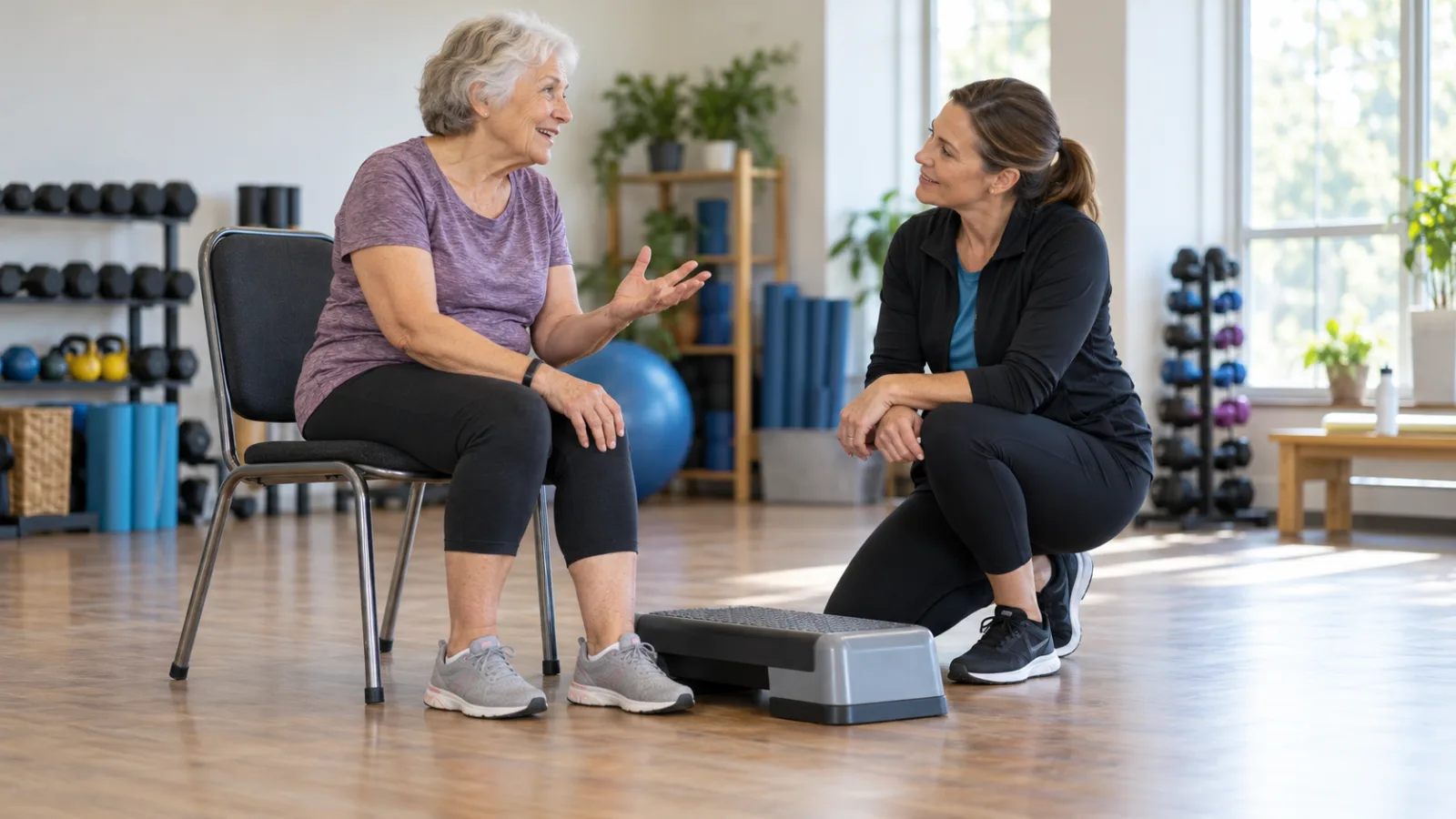
A short conversation can help you understand whether an option fits your needs. Consider asking:
A trainer should be clear about their scope. If a question concerns diagnosis, medication, treatment, a new symptom or whether activity is safe with a medical condition, ask an appropriately qualified health professional. The NHS strength and flexibility overview describes common activity types and gradual progression, while advising readers to consider what is appropriate for them.
Confidence can grow through familiarisation, clear communication and a routine that fits real life. Progress is not only a change in weight lifted or a number recorded by a device. Someone might notice that they feel more at ease in a new setting, understand how a session works, or have found an option they can attend consistently. These are personal observations, not guaranteed outcomes or a substitute for clinical measures where those are needed.
If it is useful, keep a simple note of the activity you tried, how the session felt, questions that came up and anything you would like to discuss next time. You do not need to share private health information with a provider unless it is relevant and you understand why it is being requested. Ask how information will be stored and who can see it.
There is no universal deadline for increasing the challenge. A qualified exercise professional can explain the options within their role, while a clinician can advise on health-related restrictions or concerns. If your health or circumstances change, revisit the plan with the appropriate professional rather than relying on an old routine or a general online article.
Imagine someone in their late 60s who would like to feel more confident using stairs but has not attended a gym before. They could write down what they want to ask, what settings feel comfortable and whether they have any health concerns to discuss with a clinician. They could then contact a suitable provider to ask what an initial appointment involves, what experience the instructor has with different abilities, and whether a supported or introductory session is available. This is an illustrative planning example, not a real client story, an exercise prescription or a promise about results.
Ask a GP or relevant clinician before starting if you have a condition or concern that could affect activity, have had a recent change in health, or are unsure what is appropriate. The NHS suggests GP advice for adults aged 65 and over who have not exercised for some time, have a medical condition or have concerns about activity. UK Chief Medical Officers’ guidance also says that for some older adults with frailty, moderate-to-severe dementia, a history of vertebral fractures or regular falls, new exercise may be more appropriate initially under the supervision of a trained professional.
That advice is about support and context; it does not mean that age alone is a reason to avoid activity. A clinician can help decide what information is relevant and whether a referral or additional supervision would be useful. Do not use a general article to assess a symptom or to decide that a medical review is unnecessary.
No age in this guide is a cut-off for asking about strength activity. The appropriate starting point depends on the person, their current abilities and any health considerations. The public guidance applies to adults across age groups, with specific recommendations for adults aged 65 and over. If you have concerns or a medical condition, speak with a GP or relevant clinician before choosing an activity.
No. NHS examples include resistance bands, body-weight movement, gardening, stairs, dancing and yoga, as well as weights. Whether an activity counts as strengthening depends on how it challenges the muscles. Ask a qualified professional or clinician which options fit your circumstances; a list of examples is not a personalised recommendation.
The UK guidance recommends muscle-strengthening activity on at least two days a week for adults aged 19 to 64. For adults aged 65 and over, it recommends activities to maintain or improve strength, balance and flexibility on at least two days a week. These are public-health recommendations, not an individual workout schedule. The official guidance also says that some activity is better than none.
Walking is a useful form of aerobic activity, but ordinary walking does not necessarily provide the same muscle-strengthening activity as resistance or other strengthening work. The NHS describes aerobic and strength activities as different components of its guidance. A suitable weekly mix depends on your needs and what you can comfortably do.
If you have a medical condition, a concern about exercise, a recent change in health, or have not exercised for some time, ask a GP or relevant clinician what is appropriate. The NHS gives this advice for adults aged 65 and over. If you have already received clinical guidance, follow it and ask the clinician if something is unclear.
A trainer can explain their qualifications, the sessions they deliver and any adaptations available within their scope. They should not diagnose a condition or replace a clinician. Ask the trainer how they work with clinical referrals and who to contact if a health-related question comes up.
There is no single timetable that is right for every person. UK guidance recommends building activity up gradually, and the NHS also advises gradual progression. A professional can discuss changes that fit your circumstances. Avoid treating a target, online plan or another person’s routine as a requirement for you.
Read the UK Chief Medical Officers’ guidance for the full age-group recommendations, and the NHS pages on activity for older adults and strength and flexibility for accessible explanations. The guidance is general; ask a clinician about individual health questions.
If you are looking for one-to-one support, read about personal training services and private client options. Before booking, ask what the first conversation includes, what qualifications the coach holds, and how the service handles different starting points and health-related questions.

 October 27, 2026 - BY Admin